
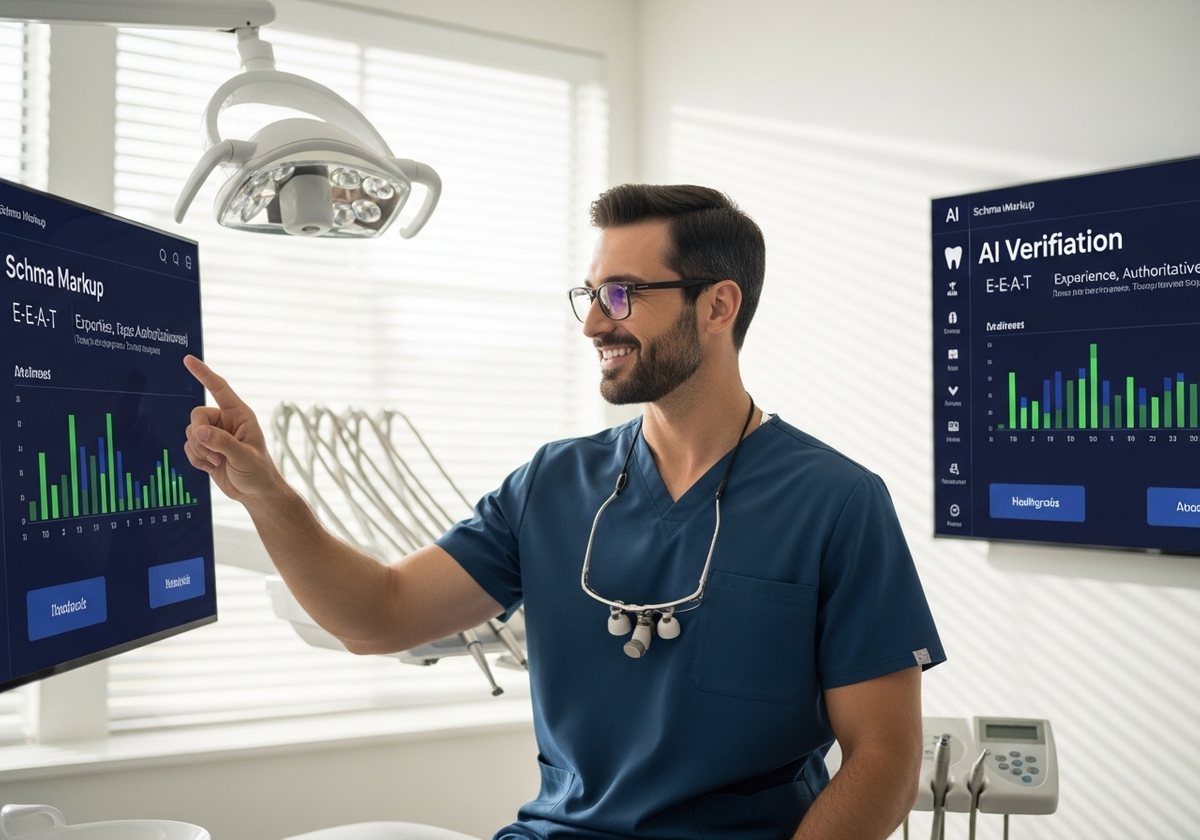
Moving from searchable to verifiable in the age of AI
In 2026, dentist marketing isn’t just about whether a patient can find your website, but whether an AI crawler—like those powering ChatGPT, Google Gemini or Perplexity—trusts what it finds there.
When a patient asks an AI assistant, "Who is the most qualified implant dentist in [Your City]?", the AI doesn't just look for keywords. It performs a verification cycle. It cross-references your website data against medical registries, board certifications and peer reviews. If the AI cannot verify your credentials through structured data, you remain invisible in the AI overviews and recommendations that now drive over 60% of new patient inquiries.
Here is your technical and strategic roadmap to ensuring AI crawlers verify your expertise.
Get Help with AI Today Call Sales
1. Speak the language of AI: JSON-LD Schema
AI crawlers are essentially pattern matchers. They struggle with flowery prose but thrive on structured data. To verify your credentials, you must use JSON-LD Schema—a snippet of code that acts as a digital ID card for your practice.
Physician & dentist schema: On your "Meet the Doctor" page, don't just list your degrees in a paragraph. Use physician or dentist schema to explicitly label your alumni (dental school), medical specialty (e.g., Periodontics), and credentials (board certifications).
Member of schema: Use this to link your entity to authoritative organizations like the ADA, AACD or local dental societies. When an AI sees a structured link between your site and the ada.org entry for your name, its confidence score in your practice skyrockets.
2. Build a digital entity beyond your website
AI models don't just crawl your site; they look for consensus across the web. If your credentials on your website don't match your Google Business Profile, Healthgrades, or Zocdoc listings, the AI triggers a data conflict and may choose not to recommend you.
The NAP+C rule: You likely know NAP (Name, Address, Phone). In 2026, we add C for credentials. Ensure your suffix (DDS vs. DMD) and your specialty titles are identical across every directory.
Claim your NPI registry data: AI models often use the National Provider Identifier (NPI) database as a source of truth. Ensure your NPI profile is up-to-date with your current practice address and specialty taxonomies.
3. Implement "E-E-A-T" with direct citations
Google’s Experience, Expertise, Authoritativeness, and Trustworthiness (E-E-A-T) standards are now the primary filter for AI-generated medical answers.
Outbound verification links: Don't just say you are board-certified. Provide a direct, "do-follow" link to the verification page of the certifying board.
Author bylines: Every clinical blog post on your site should have an author box with the doctor's name, credentials and a link to their full bio. This tells the crawler, "this medical advice is written by a verified expert, not a generic copywriter."
4. Optimize for procedure-specific authority
Verification isn't just about who you are, but what you are allowed to do.
Medical procedure schema: For high-production services like "All-on-4 Implants," use Medical procedure schema. Include the relevant specialty and indication (the problem the procedure solves).
The clinical FAQ: Structure your treatment pages with a Q&A section. Use FAQ Page schema to answer questions like, "am I a candidate for IV sedation?" This allows the AI to extract your expert answer and cite you as the verified source.
How Marketing 360® can help
Manually coding schema and syncing dozens of medical directories is a daunting task for a busy dentist. Marketing 360 provides the specialized tools you need to automate your dental marketing and manage your practice through a singe, powerful platform. Marketing 360 ensures your practice isn't just online—it's verified. We can help you build the trust signals that AI crawlers demand so you can spend your time helping your paitnets while your digital presence works to win the AI's recommendation. Contact us today!