
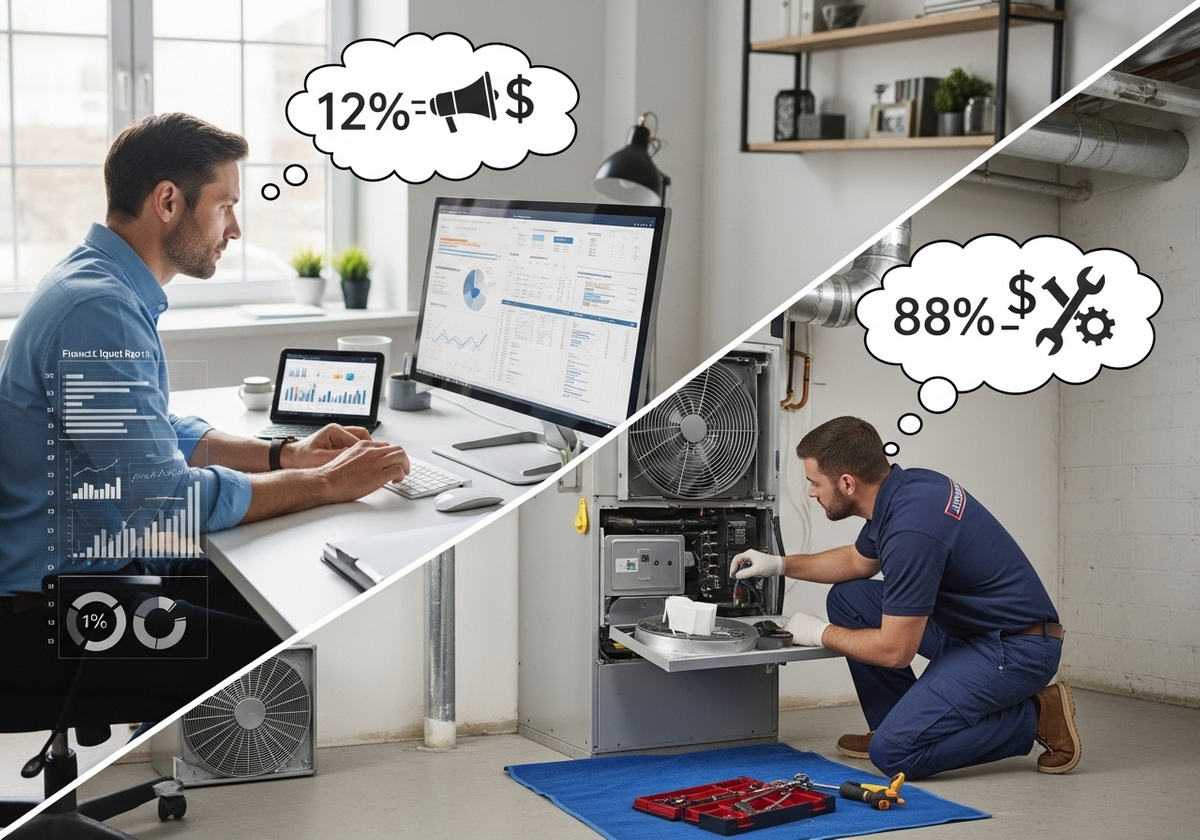
In the HVAC industry, business owners often treat marketing like a utility bill—a fixed cost you pay every month regardless of the result. But to grow, you have to stop thinking of HVAC marketing as an expense and start viewing it as a revenue generator.
The industry standard for home service businesses is to allocate between 10% and 15% of your gross revenue toward marketing. If you are a $1 million company, that means you should be investing $100,000 to $150,000 annually to sustain and grow that revenue. If you aren't hitting those numbers, you are likely under-investing in your growth.
Here is how to set, allocate and optimize that budget to ensure every dollar works as hard as your technicians in the field.
Level Up Your Marketing Call Sales
The math behind the 10% – 15% rule
Setting the budget starts with your target. If your goal is $2 million in revenue, your marketing budget sits between $200,000 and $300,000.
Why 10% – 15%? This range covers the full spectrum of lead generation needed to keep your vans rolling. It balances your baseline needs (SEO and brand awareness) with your growth needs (PPC, LSA and social ads).
The 10% floor: Use this if you are an established company with high repeat-customer rates and strong word-of-mouth. You are mostly paying to maintain your current market share.
The 15% ceiling: Use this if you are a new shop, entering a new territory or aggressively trying to capture market share from competitors. You need more noise to be heard.
Allocating your budget across channels
Once you have your number, you cannot just throw it at one platform. A healthy HVAC marketing budget follows a diversified portfolio approach to protect you against algorithm changes on Google or Facebook.
A standard split for a successful HVAC marketing budget looks like this:
30% for high-intent search: This covers Google Ads (PPC) and Local Services Ads (LSA). This is your emergency repair fuel.
25% for SEO and content: This covers your website maintenance, local SEO work and blog content. This is your long-term foundation.
20% for database marketing: This covers email, SMS and customer reactivation campaigns for maintenance plan renewals. This is your high-margin, low-cost revenue.
15% for brand and social: This covers your social media presence, recruitment efforts and day-in-the-life video content.
10% for testing and contingency: Use this for experimental campaigns or to cover unexpected spikes in lead costs.
Reverse engineering your lead needs
To truly justify this budget, you need to work backward from your revenue goal to your Cost Per Lead (CPL). If you want to add $500,000 in new revenue, you need to know exactly how many jobs that requires.
Revenue goal: You want $500,000 in new system installs.
Average ticket size: Your average install is $10,000.
Jobs needed: You need 50 new installs.
Closing rate: If your sales team closes 30% of their leads, you need roughly 167 qualified leads.
CPL calculation: If your average CPL is $150, you need an additional $25,050 in marketing spend to hit that goal.
By framing your budget through the lens of required leads rather than just a percentage of revenue, you remove the guesswork from your decision-making.
The growth versus maintenance split
As you calculate your budget, divide your spending into two buckets.
Maintenance marketing: This is the money spent to keep your current customers. This includes your maintenance plan reminder emails, SMS seasonal tune-up alerts and review management systems. This has the highest ROI because it costs far less to keep a customer than to acquire a new one.
Growth marketing: This is the money spent to find brand-new customers. This includes your LSA, PPC and targeted social ads.
If your budget is tight, always prioritize your maintenance marketing first. A loyal customer base is the safest hedge against a bad month of new leads.
How Marketing 360 can help
Setting a budget is the easy part. Managing that budget across a dozen platforms, tracking every lead back to its source and optimizing your spend in real time is where most HVAC owners burn out.
Marketing 360® provides the all-in-one platform plus a dedicated HVAC marketing team that understands the HVAC business. We help you track your revenue, cost per lead and conversion rate in one dashboard. We don't just spend your budget; we optimize it. We shift funds from underperforming campaigns to the platforms that are actually booking jobs, ensuring your 10% – 15% investment delivers the maximum possible return.
Visit www.marketing360.com to get a custom breakdown of how your marketing budget could be working harder for your HVAC business. Contact us today!